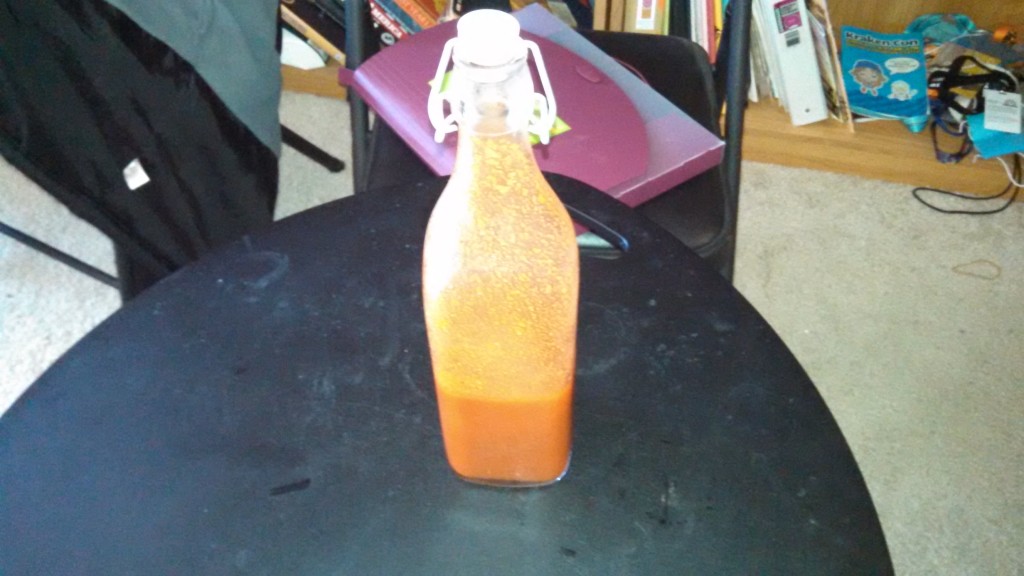
Rooster Sauce (Steve’s Sriracha)

IMG_20141223_113953_612

So in the end I decided to learn how to make Sriracha.  I am not addicted to the sauce like many, but it’s OK and it’d be nice to have a good hot sauce – oh, and it’s fun to try.  Here’s my first round.

  • 2 lbs red chili peppers; I used jalapeños.
  • 3 Tbsp maple syrup
  • 4 Tbsp crushed garlic cloves garlic (12 cloves)
  • 1 Tbsp salt
  • ½ cup red wine vinegar
  • 1 tbsp soy sauce
  1. Remove step and split peppers
  2. Puree all ingredients but red wine vinegar and soy sauce in blender into a coarse mix.
  3. Place mix in airtight jar. Leave for seven days, stirring once a day with a wooden spoon.
  4. Place mixture into pan with vinegar, bring to boil, simmer 5 minutes, let cool. Stir.
  5. Place mixture into a strainer over a bowl. Press mixture with wooden spoon repeatedly to drain all the liquid.
  6. Add soy sauce to drained liquid. Pour liquid into an airtight bottle via a funnel.
  7. Store in refrigerator. May keep up to six months, but not sure.

The result?  Not bad the first try, it’s got a good taste, a slow but not unpleasant burn afterwards, a bit like a tabasco, though frankly I like it far better than tabasco.  Not as much character as I’d like, probably as it’s really just a pile of jalapeños, and I think I got the garlic wrong.

However it’s still darned tasty, makes a good hot sauce, and has that fresh, home-made taste that is just unique.  I also mix it with equal parts soy sauce as an absolutely amazing dip.

So next try, I’m going to drop a few jalapeños, add a habanero and a regular red pepper for diversity, double the garlic, maybe add one more tbsp maple syrup, and possibly twice the soy sauce.

However until then, I’ll enjoy this . . .

<strong>- Steven Savage</strong>

Steven Savage is a Geek 2.0 writer, speaker, blogger, and job coach.  He blogs on careers at http://www.musehack.com/, publishes books on career and culture at http://www.informotron.com/, and does a site of creative tools at http://www.seventhsanctum.com/. He can be reached at https://www.stevensavage.com/.

Civic Geek Catalog Update 12/27/2014

This week’s big focus is on electronic recycling – which will be a theme of my upcoming column.  Plenty of ways to get involved, recycle electronics, and go good at the Civic Geek Catalog.

And don’t forget you can find causes sorted by Geekery or by Focus!

Computing

  • Electronic Reuse and Recycling
    • Close The Gap – Takes computer donations from european countries and refurbishes them for emerging nations. Also works to recycle unusable equipment safely.
    • Computers With Causes – Takes donated computers and either gets them to charitable programs, or sells them for funds used to go to programs
    • PCS For Schools – Refurbishes and upgrades donated computer equipment and uses it to bridge the technology gap in schools
    • World Computer Exchange – A US and Canadian non-profit that reduces the digital divide with education, donated computers, and more.

Technology

  • Electronic Reuse and Recycling
    • AZ StRUT – Arizona chapter of Students Recycling Used Technology, an organization that supports learning, refurbishing and donation of electronics, and proper recycling of electronics.
    • Cell Phone Bank – Takes donations of cell phones and recycles them for use as emergency phones.
    • Cell phones For Soldiers – Provides refurbed cell phones and more to soldiers so they can keep in touch.
    • Green Electronics Council – A nonprofit focused on environmental leadership in electronics
    • Hope Phones – Outfits global health care workers (part of Medic Mobile) with donated cell phones
    • Komputers4rkids – Focused on Southern California, the goal of Komputers4rkids is to bridge the digital gap in technology, and they accept electronic donations to help do it.
    • National Center For Electronics Recycling – A nonprofit that works to build and coordinate initiatives to improve electronic recycling.
    • Silicon Valley StRUT – California/Silicon Valley chapter of Students Recycling Used Technology, an organization that supports learning, refurbishing and donation of electronics, and proper recycling of electronics.
    • Step Initiative – The Step Initiative takes a long-term view of understanding, planning for, recycling, and avoiding e-waste.
    • The Christina Foundation – Promotes technology reuse and helps connect people with local organizations and individuals that need their donations.
    • Wireless Foundation – Recycles used cell phones and focuses on stopping family violence

– Steven Savage

Steven Savage is a Geek 2.0 writer, speaker, blogger, and job coach.  He blogs on careers at http://www.musehack.com/, publishes books on career and culture at http://www.informotron.com/, and does a site of creative tools at http://www.seventhsanctum.com/. He can be reached at https://www.stevensavage.com/.

Way With Worlds: It Comes Apart – People And Conflict

shattered face statue

(Way With Worlds is a weekly column on the art of worldbuilding published at Seventh Sanctum, Muse Hack, and Ongoing Worlds)

For the next few columns I’m going to be exploring the dysfunctions and conflicts in the worlds we create. Not conflicts brought about by our mistakes as worldbuilders (though those can become fuel for deeper worldbuilding as noted), but what happens when things break down? Sure we’re all busy building our world, but things go wrong inside the worlds as part of good worldbuilding, and we have to figure out the implications of the crises we create.

In fact, as repeated several times, conflict is actually part of the process of making a world accessible and interesting. People want to hear stories and play games about things that happen, and that often involves conflict. Not always of course, but often enough it warrants its own section here in a series of columns by a slightly-mad-scientist of randomizing ideas.

Now everyday conflicts are one thing; arguing over a tab, not being able to find dragon dung at the alchemist’s shop, and so on. Let’s talk about the big ones, the ones that are epic and horrible, the ones we write about – and the ones that in real life make us wonder why the hell they happened.

So let’s go and find out just how things break down and go wrong. We’ll start with how it stays together in the first place – well, how our cast of characters and people keep it together.  After all, they’ll be the ones you’re writing about or your players are playing.

Also they’re probably the ones causing the problems . . .

Read more