A Writer’s View: System Thinking

(This column is posted at www.StevenSavage.com and Steve’s Tumblr)

This Tweet got me thinking:
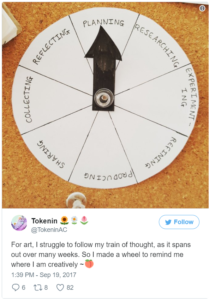
Neat idea for a creative person, right?  Tracking their creative stages?  It’s a good example of a creative person finding a way to work with their inspiration and habits.  It’s a system.

Good creatives, successful creatives, have systems.  You can hear about the Snowflake Method, or the “X Habits of Whatever,” or endless ideas of how to write novels, or best ways to do art.  You doubtlessly have your own way of organizing your creativity – even if you’re not aware of it.  For all our raging imaginations, it seems we creative people often make ways to organize that fire that burns inside of us.

There are several reasons we do this – reasons we’re not always aware of, but by bringing it into awareness I hope it helps you make your own.

We organize our creativity to ensure things get done.  Being creative is nice, but if there’s no end result, there’s little point unless you’re doing something freeform.

We organize our creativity to provide focus.  So we make sure we don’t loose track, so we can bring projects to completion, so we don’t start anything new.

We organize our creativity to speed time to completion.  We get structure and organization, milestones and ways to track progress – so that creative dream sees the light of day.

We organize our creativity to embody our principles.  We take ideas of what matters, our mad methods, our special tricks and make them formal so we can use them that much easier.

Finally, an an oft missed benefit, is that by organizing our creativity we can find ways to improve.  When you build a system of ideas, of tracking, of documenting you can use that to find new ways to do better.  That organization of imagination can inspire you to think up new ways to get better.

So, go on, take a look at your creativity.  What systems and methods do you have?  What could you build?  How can you provide enough structure to your dreaming to make you dream better?


(Remember I do all sorts of books on creativity to help you out!)

– Steve

A Writer’s View: Pitches And Product

(This column is posted at www.StevenSavage.com and Steve’s Tumblr)

Lately Serdar was commenting on the use of pitches in our writing.  I tend to love making them, and he calls out my current work, “A Bridge To The Quiet Planet” which I summed up as “A sorceress, an engineer, and a priest on a planet-hopping road trip with the owner of a mysterious collection of holy books.”  As amusing as such pitches/summarites seem, they’re actually powerful tools for writing – not just marketing.

The way I use pitches/summaries comes from a mix of my own research into resumes (which are a kind of writing), Agile Product Ownership, the theories of Joel Orr, and the must-read Snowflake method.  They’re not just a way to sell your book – they’re a way to help you write your book.   Stick with me here – let me walk you through an exercise.

Go and take a communications project and sum it up in one sentence.  Such as:

  • Superintelligent whales end up in a religious war over the controversial theory they were created by beings called “humans.”
  • A no-nonsense guide to building your writing career by setting, measuring, and meeting goals.
  • A song parodying internet memes by calling out as many as possible in alphabetical order.

OK, we’ve got three summaries – which are also pitches.  I’m sure at least one might interest you and one might horrify you, but let’s go on.

Now, imagine someone doing any of the above projects takes the summary and then begins to outline the project, figuring what’s really going on in it.  That pitch, summary, acts as a seed and gives you something to aim for – and also an idea of what the boundaries of the project are.  The summary helps you focus (or in some cases, realize the summary is bunk and start over).

But, somewhere in that outline, you may find the summary should change a bit.  The deeper you get in touch with the work, the more you find that one sentence may not communicate it.  So, perhaps you change it.  The summary defined the goal, the work on the project made you rethink it slightly, and so on.

  • Superintelligent whales disagree over the theory they were created by “humans,” which plunges them into a species-threatening religious war with an unsure outcome. (Changed because it gives a better idea of the plot).
  • A practical, step-by-step guide to a writing career with measurable goals and milestones that anyone can use. (Changed as it focuses the goal more)
  • An electronica song that parodies the most enduring internet memes – in alphabetical order. (Describes better, more clear goals).

It’s a dialogue. You have a summary, then an outline, which may influence each other.  Then as you flesh out your work you may change the outline, or the summary, and vice versa.  The ability to write summaries and pitches gives you the ability to create a dialogue among all levels of your work so they stay coherent – because it all comes back to making sure the summary is accurate.

If you can get an idea of what your work is about on all the different levels, from a summary to a scene, from character arc to story arc, you have a much better idea of what’s going on.  In turn, you’ll make a better work because all your work, at all levels, keeps reinforcing what you’re doing.

Plus you get a great sales pitch that’s been well-honed!


(Remember I do all sorts of books on creativity to help you out!)

– Steve

A Writer’s View: Audience Interest

(This column is posted at www.StevenSavage.com and Steve’s Tumblr)

One of the things I always worry about my return to writing is “will people want to read my work?”  My friend Serdar has analyzed this in one of his blog posts (with the winning title “If I Had More Time, I Would Have Written a Shorter Novel“).  He focused on novel length in many cases, and asked himself why some large works are worth the time and others are not.

What’s interesting is his next book is 230k words.  “A Bridge To The Quiet Planet” is probably clocking in around 110K.  But we both ask ourselves “Why do people care.”

We have to make it worth their time (and money), it must engage them.  I can think of two ways we may do this off the top of my head:

Something To Care About

Serdar hits on one by noting:

. . . the trick, I guess, is to package them up and offer them in a way that other people can pick up on, in their own way, what the interesting things are. Anime and manga have whole subgenres that revolve around the mastery of a skill (a sport, a game) or the deep investigation of a mundane everyday occupation. They take something that to an outsider would be meaningless and they invest it with the urgency of The Great Work Of Life And Death. It makes a striking contrast to stories that involve casts of thousands and the fate of nations but evoke little more than a gurgling snore.

You have to write about stuff people care about or make them care by getting them invested in the characters, the setting, etc.  If you can connect people to the work (often through characters) then they will buy into it.  They will give a damn.

For my own example, let’s take Yuri On Ice, the gay romance men’s figure skating drama you didn’t know you wanted, and that is a runaway hit.  I have watched it twice because I like the characters, I like humor, and I like all the substories.  I felt like things were happening to people, and thus was engaged on a subject that I frankly didn’t care about – skating.

OK I didn’t like Chris, he’s a creep, but anyway.

Something To Learn

I am a very detail driven person – which makes sense as I write books on Worldbuilding.  I love bits of revelation and backstory as the world comes into focus, as we learn more about the characters.  Even if the details aren’t relevant to the story, they help you understand things.

You can also get interest if you’ve got plenty of things revealing and being found out and pace yourself.  If people keep learning, keep finding out new things – plot-related or not – they’ll be interested.  The best things of course are revelations that tie to the plot, but having fun little details also just makes the story and characters real.

An example I’ll give from this is the under-appreciated military-sf-horror film Spectral, which I strongly recommend (warning, link has spoilers).  You get slow revelations over time, and only truly get the full story in the last five minutes.  Each little bit, each finding about the horrors the characters face, each choice to fight back, each revelation as they try to out-think the forces against them, kept me hooked.

Keep People Engaged

You can make a 10 page short story a slog and make a 500 page novel that people loose track of time reading.  It’s all how you can get them engaged.  And it determines if it was worth their time.

(Remember I do all sorts of books on creativity to help you out!)

– Steve