True Creative Motivation

(This column is posted at www.StevenSavage.com and Steve’s Tumblr.  Find out more at my newsletter.)

Motivation is critical to an artist.  Motivation is what drives you.  Motivation is about what you want to do and why you want to do it.  When all goes dark, motivation is the spark that can light your way – or light a fire to burn down obstacles.

Thus motivation and understanding your motivation is critical to any creative effort.  Being “in touch” with your motivation can drive you and guide you – and help you set and reach goals.

Of course we’ve also felt lacks of motivation.  Of having our drives vanish.  Of not knowing “why.”  Loosing motivation is equally dangerous, but there’s something worse.

There’s finding your motivation isn’t your own.

Many times friends and I who are writers, artists, and other creatives discuss why we do things.  The funny thing is, we often have very different goals and reasons.  This takes us all in different directions, but also helps us know where we have common ground or learn from contrasts.  However, now and then we find our motivations to feel wrong, or encounter fellow creatives whose motivations seem shallow and unhelpful.

Something that came up in a recent conversation was this – some creatives are motivated by other people’s motivations.  They’re doing thier work, driven by what drives others, having assumed “I do X so I should be motivated by Y.”

A few examples:

  • Writers who think they must make a living at it.  However, there’s many ways to make money, so why use writing?
  • Artists who want to work in a specific industry because “that’s where everyone goes” – missing the many other options.
  • Cosplayers who assume they have to follow in the footsteps of the Big Names.
  • People who assume that liking games means they should be in the games industry.

Now and again me and my friends find people motivated by what they think their motivation should be.  It rarely goes well for such people – they’re not driven, they’re not embracing their creative lifestyle, they’re not engaged.  Hell, in many cases they just stop caring.

As a creative, find what really motivates you.  It may shock you.  It may disturb you.  It may not even be there, requiring you to do some hard thinking or go on a kind of vision quest.  But having real motivation means you’re really engaged in your work.

Don’t operate off of stolen motivation.  Creativity is unique, personal and intimate – so your own motivation will unique, it will be part of who you are, and it will tie deep into your life and experiences and goals.


Steven Savage
What If It Ended?

(This column is posted at www.StevenSavage.com and Steve’s Tumblr.  Find out more at my newsletter.)

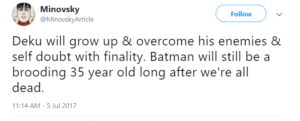
This tweet struck me hard.  It made me think about my talks of Media Gray Goo.  I realized that age plays a role in my concern that our media is becoming dull and repetitious, that there are things we do over and over and over until they loose all meaning.

Here we see an example of that in discussing Batman, the ever re-invented character who bears both the burden of the past and the burden of endless re-interpretation, all fused into a kind of incoherent and re-invented continuity.  We’re always re-making Batman while acting like he’s the same, which in time seems to whittle the character down, despite some spectacularly well-done takes.

Batman is endlessly stuck at 35, even when authors temporarily play with him until someone presses the reset button.  How many fan arguments are based on what Batman “should be,” even though he’s both out of date and remade?  How much of him has become Gray Goo?

Above, the author gives the example of Deku of My Hero Academia.  He has a story, he ages, he grows, and in theory his tale may end, though as we’ve seen from One Piece, some manga and anime do go on.  There’s no plans to reboot him, remake him – indeed, the entire My Hero Academia universe presents so many options why would you want to remake it – there’s so many other stories to tell and explore anyway.  And if it ends, then it ends – there’s plenty of other cool stuff.

In fact, if a story has a good tale and a good arc, why not enjoy a good end?  Maybe follow up with the rest of the setting, other characters, and so on.  Let things grow – and if you miss the old tale, then re-read it or re-view it.  You can discuss something in context, while also acknowledging all its flaws and places in time.

So I want you to imagine a different world, where superheroes had their stories and they ended.  Where we dig up reprints of old Batman comics, with their starts and endings, and if Batman is remade then it’s a remake of a tale with a start and a finish.  Imagine being able to enjoy Batman in context and history, not as ever-remade battles of marketing and reboots and a return to zero?

Maybe we need to let things end or pass on.  That’s what’s life about after all.

Steven Savage

Media Gray Goo

(This column is posted at www.StevenSavage.com and Steve’s Tumblr.  Find out more at my newsletter.)

Every now and then (OK, weekly), something Very Dumb happens involving a piece of mass culture media. People meltdown because of some casting. Someone gets fired because of saying something controversial like “hey, don’t be a douche.” Some new thing comes out that really just builds on something else, and we vaguely care.

How much of our minds get occupied by stuff like Marvel, DC, Star Wars, Doctor Who, Star Trek, and the like? How much of our culture involves these works? How many people hang on every new book, idea, episode, etc. Geek that I am, I’m starting to wonder if this has gone very, very bad.

Let’s imagine how a healthy body works. Yes, it’s a unified whole, but also it’s got specific parts and is filled with checks, from antibodies to the ability to vomit bad food to neurons holding back other neurons from doing something terrible. A body is a single thing composed of parts that are both linked and independent in some ways (but not separate from the body).

A body that was one giant unified mass is basically an amoeba or The Blob.

Now let’s ask about a healthy culture. Shouldn’t it be the same way? There are dominant cultural elements, and many subcultures, specialized knowledge, and generalized knowledge. There will be conflict, but often in service of a larger whole – subcultures generating widespread ideas, widespread ideas passing their time and going to memory, etc.

A culture that is one giant unified mass is a gray goo of nothing, large but nothing to hold on to, nothing relevant to the individual.

I’m thinking our mass culture is becoming a mass of gray goo. Sure some of it may be great gray goo, but overall it seems to be samey even when good. I’m glad we can re-invent things (Like Jodie Whittaker’s Doctor, who I loved), but why do we have to keep doing the same thing?

Worse, doing the same thing keeps giving power to the same group of people and companies (usually Disney these days). We’re letting people own vast chunks of our culture, and the inevitable battles between “do it good and interesting” and “give me the gray goo I expect” are exhausting. Besides, we know in the end that the big companies are going to play it safe – and safe isn’t always the best thing for the culture.

(Think of it as being like your brain overruling your body’s warning signals to keep drinking and eating cheeseburgers.)

This is probably why some big companies like Netflix and Amazon caught on and are working on churning out different stuff. It’s perhaps why we see authentically good media as well because some people got that there needs to be more. I can critique the hell out of them for many reasons, but I can acknowledge smart plays against gray culture goo.

So now I want to imagine a different media culture.

Imagine a media culture with few to no dominant media properties. Imagine things actually ending for a change, and excellent media being rerun or reread instead of being extended. Imagine not having cultural space taken up by gray goo, but more, smaller things.

Imagine if you do get into something that is a long-term media commitment, that it’s a more intimate experience. That TV series going on for a decade and its spinoffs don’t have to be forced into our consciousness. Imagine fandom as more interlinked preferences than A Big Thing.

Imagine more originality or at least new versions of the same old thing.

This is going to sit with me awhile. It makes me think about my own tastes, about what matters, and about what I’m writing.

Steven Savage